New vs. Used Acoustic Pianos: Which Should You Buy?
Once you decide that an acoustic piano is right for your home, the next question is often whether to buy new or used.
Both can be excellent choices. A new piano offers predictable condition, warranty protection, a wider range of current models, and the opportunity to establish its care history from the beginning. A well-chosen used piano may allow you to buy a larger, higher-quality, or more distinctive instrument for the same budget.
The best choice depends on more than price. Your priorities, playing goals, budget, and the condition of the individual piano all matter. Understanding the advantages and tradeoffs of each option will help you compare instruments with greater confidence.
For a broader overview of tone, touch, size, quality, and other buying considerations, start with our guide to buying an acoustic piano.
Advantages of buying a new acoustic piano
For many buyers, the greatest appeal of a new piano is predictability. The instrument has no previous wear, no unknown maintenance history, and no questions about how it was stored or cared for.
The main advantages include:
More choices in models, finishes, and features
Buying new usually gives you more flexibility in size, style, finish, features, and price. Rather than choosing only from the used instruments currently available, you can compare a broader selection of current new pianos across manufacturers and model lines.
Warranty protection
New acoustic pianos generally include a manufacturer’s warranty covering qualifying defects in materials or workmanship. Warranty terms vary, so it is still important to understand what is included and how service is handled.
Known condition and history
With a new piano, you begin its maintenance history yourself. There is no uncertainty about previous climate exposure, moving damage, heavy use, or missed service.
No previous mechanical wear
A well-made acoustic piano can provide decades of use when properly maintained. Buying new allows you to begin with an instrument whose action, strings, and other components have not experienced years of prior use.
Current designs and features
New acoustic pianos may incorporate recent refinements in design, manufacturing, materials, and consistency. Buyers can also choose from current models equipped with silent play systems, recording capabilities, or other integrated technology.
The principal tradeoff is cost. A new piano will usually require a larger initial investment than a comparable used instrument. New pianos also tend to need attentive tuning during their first year as the strings and wooden components adjust to their new environment.
Advantages of buying a used acoustic piano
One of the strongest reasons to consider a used piano is value. Depending on the instrument, buying used may allow you to choose a larger piano, a higher-quality model, or a brand that would otherwise be beyond your budget.
The main advantages include:
More piano for your budget
A carefully selected used instrument may offer strong musical quality at a lower price than a comparable new model.
That may mean moving from an upright to a grand, choosing a larger instrument, or purchasing a higher-quality piano than your budget would allow new.
You can also browse our current selection of used pianos in Denver to see how sizes, ages, brands, and price points compare.
Character and individuality
No two acoustic pianos sound or feel exactly alike, and that can be especially true in the used market. Some buyers are drawn to an instrument because of its particular tone, touch, cabinet style, or history.
Discontinued models and styles
Used inventory can include sizes, finishes, cabinet designs, and models that are no longer being produced. For buyers looking for something specific or less common, that broader range can be appealing. Some older premium pianos may also be worthwhile candidates for professional rebuilding, placing them in a different category from ordinary used instruments.
A more accessible starting price
Used pianos are available across a wide range of price points, which can make acoustic piano ownership more accessible without necessarily limiting buyers to entry-level instruments.
The tradeoff is that used pianos vary more widely in condition. Two instruments of the same age and model may have had very different lives. Climate, use, maintenance, moving history, and previous repairs can all affect how a piano performs today and how much service it may need in the future.
That does not make used pianos a poor choice. It simply means the condition of the individual instrument matters more than the label “used.”
What should you consider when buying a used piano?
The condition of a used piano depends on more than its age or appearance. Its environment, maintenance, use, construction, and preparation can all affect how it plays today and what it may need in the future.
Chronological age
A piano’s age is important, but it’s only one part of the picture.
Two pianos built in the same year can be in very different condition, depending on how often they were played, whether they were maintained regularly, how many times they were moved, and the climate in which they were kept.
In practical terms, a used piano has both a chronological age and a kind of “mileage” based on how heavily it was played, maintained, moved, and exposed to changing conditions.
A newer piano that spent years in an unstable environment or received little maintenance may be in worse condition than an older piano that was played moderately and cared for consistently. At the same time, even a well-maintained piano will experience normal wear as its wooden, felt, leather, and metal components age.
The serial number can usually help identify when and where the piano was made. Age provides useful context about the instrument’s design, materials, likely remaining service life, and whether major components may be approaching the point when repair or replacement becomes necessary.
Condition and maintenance history
A piano’s present condition depends heavily on its environment and use. When that information is available, useful questions include:
- Has it been tuned and serviced regularly?
- Has it been exposed to large swings in humidity or temperature?
- Was it played lightly, or used heavily in a school, church, studio, or performance setting?
- Has it been moved frequently?
- Have repairs or replacements been completed, and were they done well?
This is why a used piano should be judged as an individual instrument rather than by age or brand alone.
Mechanical and structural condition
A used piano can look beautiful and still have mechanical or structural issues that are difficult for an untrained buyer to recognize. Minor scratches, fading, or cabinet wear do not necessarily reflect the piano’s musical condition, just as a polished cabinet does not guarantee a healthy instrument.
Before purchasing one, it is important to understand its condition beyond the cabinet and finish. The most important areas include:
- Tuning stability: A piano should be able to hold its tuning reasonably well. Loose tuning pins, changes in the pinblock, or long periods without service can affect stability and may lead to more significant repair needs.
- Soundboard and structural condition: The soundboard, bridges, plate, and other structural components all contribute to the piano’s tone and longevity. Not every crack or visible imperfection is serious, but structural concerns should be evaluated by someone who understands how they affect the instrument as a whole.
- Action condition: The action contains thousands of moving parts made from wood, felt, leather, and metal. Wear can lead to an uneven or sluggish touch, inconsistent repetition, unwanted noise, or difficulty controlling dynamics. Some action wear can be corrected through regulation or replacement of individual parts. More extensive wear may require a larger investment, so it is important to understand what the piano needs before you buy it.
- Preparation before sale: A used piano should be evaluated, serviced, and prepared before it is presented as ready for a new owner. That may include cleaning, tuning, regulation, voicing, repairs, or replacement of worn parts, depending on the instrument. Preparation can make a meaningful difference in how a piano sounds and feels. It can also help distinguish a properly serviced used piano from one being sold as-is.
For a closer look at what that work can involve, see What Is Piano Preparation, and Why Does It Matter?
Should you buy a used piano privately or from a dealer?
Where you buy a used piano can affect its price, preparation, warranty coverage, and the support available after the sale.
Buying privately
A private sale may offer a lower purchase price, but the piano is usually sold as-is. That means the buyer is responsible for arranging an inspection, moving, tuning, and any repairs the instrument may need.
Before purchasing a piano privately, it is wise to have it evaluated by an independent piano technician. A professional inspection can help identify structural, mechanical, or maintenance concerns that may not be obvious during a brief visit.
You should also factor in the full cost of bringing the piano into your home, including:
- Professional moving
- Inspection
- Tuning or pitch correction
- Cleaning
- Regulation or repairs
- Removal or disposal if the piano is ultimately not suitable
A low purchase price does not always mean a low total cost.
Buying from a reputable piano dealer
A reputable piano dealer should evaluate a used instrument before accepting it for sale and prepare it before placing it on the showroom floor.
Depending on the piano, that preparation may include cleaning, tuning, regulation, voicing, repairs, or replacement of worn parts. Dealers may also provide delivery, warranty coverage, service support, or a trade-up policy.
These protections do not eliminate the need to ask questions. Buyers should still understand:
- What preparation has been completed
- What the warranty covers
- Whether delivery is included
- What service is recommended after purchase
- How any trade-up policy works
- Whether the piano has been owned, traded in, or placed on consignment
The advantage is not simply convenience. It is greater clarity about the piano’s condition, along with whatever warranty, service, delivery, or trade-up support the dealer provides.
New vs. used acoustic pianos at-a-glance
Neither option is automatically better. The right choice depends on which benefits matter most to you.
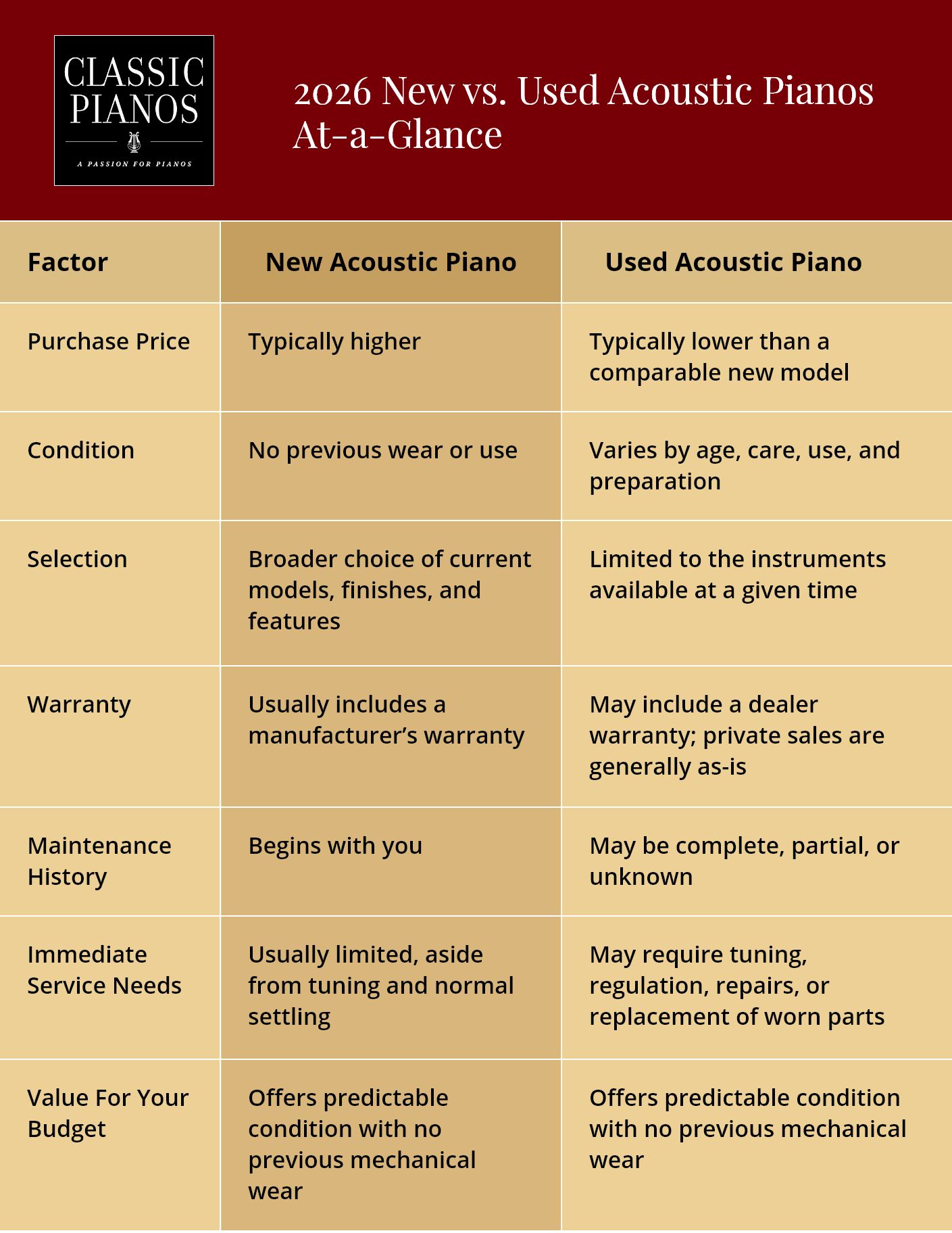
| Factor | New Acoustic Piano | Used Acoustic Piano |
|---|---|---|
| Purchase Price | Typically higher | Typically lower than a comparable new model |
| Condition | No previous wear or use | Varies by age, care, use, and preparation |
| Selection | Broader choice of current models, finishes, and features | Limited to the instruments available at a given time |
| Warranty | Usually includes a manufacturer warranty | May include a dealer warranty; private sales are generally sold as is |
| Maintenance History | Begins with you | May be complete, partial, or unknown |
| Immediate Service Needs | Usually limited, aside from tuning and normal settling | May require tuning, regulation, repairs, or replacement of worn parts |
| Value for Your Budget | Offers predictable condition with no previous mechanical wear | Offers predictable condition with no previous mechanical wear |
How to compare new and used pianos in person
When comparing new and used pianos side by side, it can be helpful to begin with a new instrument. This gives you a reference point for how a piano with no previous wear responds, sounds, and feels.
From there, try several used pianos and pay attention to the differences in tone, touch, responsiveness, and consistency. A used piano does not need to feel exactly like a new one. The comparison simply gives you a better sense of how each instrument performs and which one feels best to you.
A new piano may be right for you if …
- You want the widest possible choice of models, finishes, and features.
- You prefer a piano with no previous wear or unknown history.
- Manufacturer warranty coverage is important to you.
- You plan to keep the piano for many years and prefer to begin with an instrument that has no previous mechanical wear.
- You are comfortable making a larger initial investment.
A used piano may be right for you if …
- You want to maximize the quality, size, or brand available within your budget.
- You are open to choosing from a changing selection of instruments.
- You have found a piano whose tone and touch appeal to you.
- Its condition and service needs have been professionally evaluated.
- You understand what preparation, warranty, delivery, and future maintenance are included.
In either case, the individual piano matters more than the category. A well-chosen used piano can be a better fit than the wrong new piano, just as a carefully selected new piano may offer greater long-term value than a used instrument that needs substantial work.
Compare new and used pianos in Denver
The differences between new and used pianos are easiest to understand when you can hear and play them side by side. At Classic Pianos Denver, you can explore new and pre-owned pianos, compare their tone and touch, and ask questions about condition, preparation, warranty, delivery, and recommended care. Visit our Denver showroom at 1332 S. Broadway, or call 303-777-2636 to speak with our team. We’ll help you compare instruments at different price points and find a piano that fits your goals, your home, and the way you want to make music.
Frequently asked questions
Do new pianos need more frequent tuning during the first year?
Often, yes. A new piano continues to settle and adjust after leaving the factory and entering a new environment. Changes in string tension and humidity can affect its tuning stability, particularly during the first year or two.
Recommended schedules vary by manufacturer, instrument, climate, and use. Your dealer or piano technician can recommend an appropriate schedule for your piano and home.
How can I determine the age of a used piano?
Most acoustic pianos have a serial number that can be used to estimate when the instrument was made. On an upright piano, it is often found inside the top lid near the cast-iron plate. On a grand piano, it may appear near the tuning pins or beneath the music desk.
A piano dealer, technician, manufacturer, or serial-number reference guide can help identify the production year. Keep in mind that age is only one factor. The piano’s condition, maintenance history, use, and environment are equally important.
Should I have a private-sale piano inspected before buying it?
Before purchasing a piano privately, it is wise to have it evaluated by an independent, qualified piano technician. A Registered Piano Technician, or RPT, has passed examinations administered by the Piano Technicians Guild in piano tuning, repair, and maintenance.
An inspection can help identify concerns involving tuning stability, structural condition, action wear, previous repairs, and likely service needs. It can also help you determine whether the asking price is reasonable given the piano’s condition.
What is the difference between used, refurbished, rebuilt, and restored?
These terms are not always used consistently, so it is important to ask exactly what work has been completed.
- Used means the piano has had a previous owner. It may be sold as-is or may have received routine cleaning, tuning, and adjustment.
- Refurbished generally means the piano has been cleaned and serviced, with selected repairs or worn parts replaced.
- Rebuilt usually refers to extensive work involving major structural or mechanical components, such as the strings, pinblock, soundboard, bridges, or action.
- Restored often describes work intended to return an instrument to an earlier condition or preserve historically appropriate materials and design.
The scope and quality of the work matter more than the label. Ask for a written explanation of what was repaired or replaced, who performed the work, and whether the work is covered by a warranty.
Is a free piano ever worth considering?
It can be, but a free piano is not necessarily an inexpensive piano.
Before accepting one, account for the cost of professional moving, inspection, tuning, cleaning, repairs, and possible disposal. A free piano in sound condition may be worthwhile, but an instrument with serious structural or mechanical problems can cost more to make playable than it is worth.
Having the piano inspected before arranging the move is usually the safest approach.